Remain in contact with reality
GHOST LINK
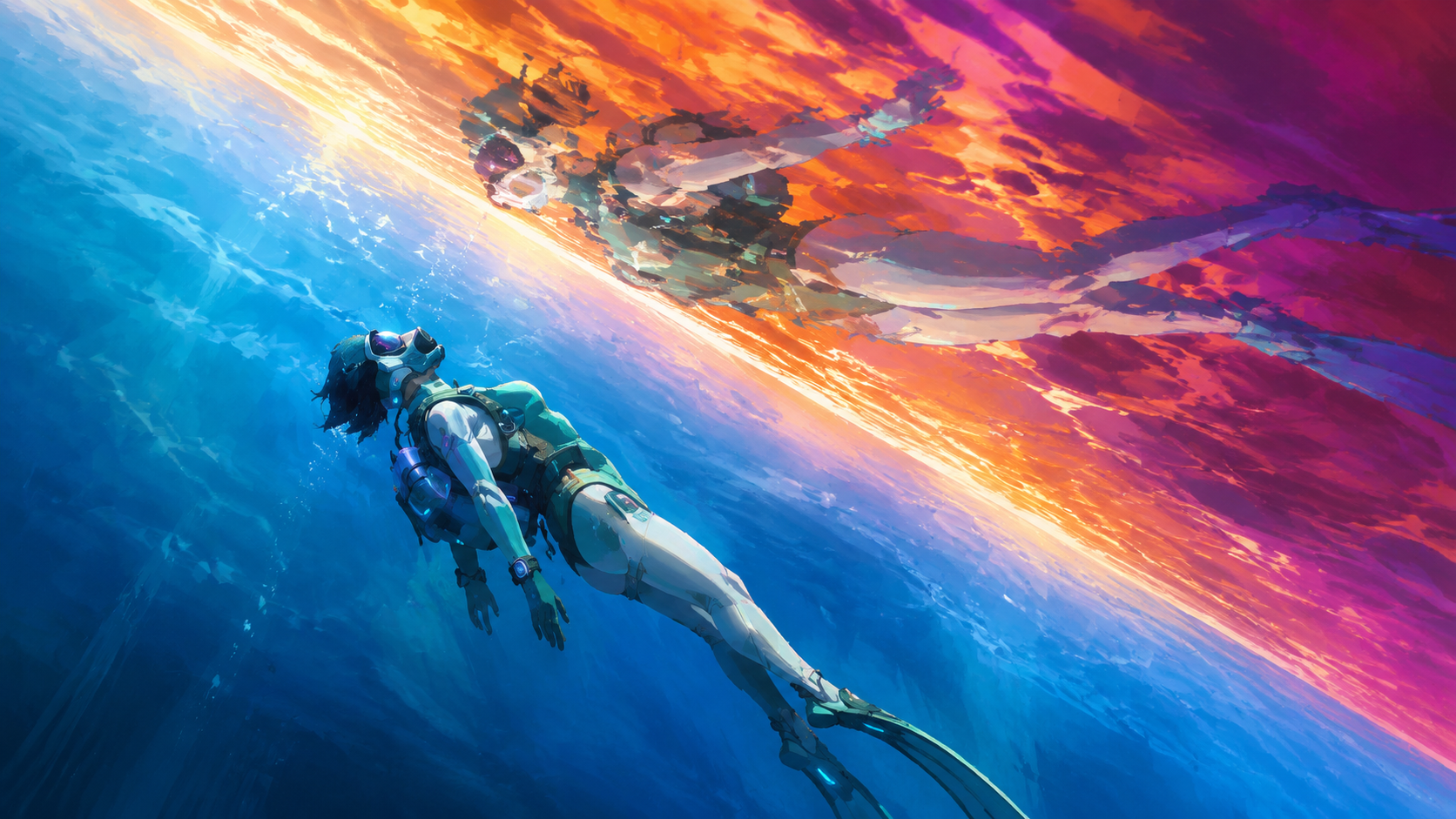
A psychological portrait
Motoko Kusanagi
THE SELF ASORIENTATION
When body, memory, and biography can no longer certify the self, identity survives not as a possession—but as a direction.
01
Identity center
What remains
Her identity has structure.
It does not have walls.
Major Motoko Kusanagi lives under a pressure most people encounter only in fragments. Her body does not certify her identity. Her memories cannot be treated as inviolable evidence. Her senses can be deceived, her mind penetrated, and her consciousness connected to systems vastly larger than herself.
Yet she does not become less human under this pressure. She becomes a study of what remains when nearly every conventional proof of humanity has been made uncertain. What remains is orientation.
“The Major knows herself by recognizing the direction in which her ghost continues to move.
CONTINUITY WITHOUT IMMUTABILITY
Preserve the possibility of choice
Do not confuse a category with the thing itself
Recognize life where the system sees only function
Follow the anomaly far enough to discover its meaning
Act when certainty ends — and answer for what follows
Her competence is not performance. It is the instrument through which her orientation enters the world.
The Major can abandon a hypothesis without experiencing defeat as humiliation. She can encounter an intelligence greater than her own without needing to diminish it. She can be altered by what she discovers without interpreting change as the destruction of self.
02
Second-order intuition
At the frontier of analysis
The ghost
whispers.
Not blind impulse. Not mystical certainty. The moment when perception, experience, value, and pattern recognition converge before conscious language can explain their conclusion.
Something is wrong. This person is lying. This pattern does not belong here.
What kind of reality would make this contradiction possible?
Intuition opens the path. Contact with reality tests it.
03
Humanity under pressure
Not origin. Response.
A machine executes.
The Major decides.
Her humanity is not preserved by the discovery that some biological remnant survived inside her. It survives through her relationship to existence: surprise, recognition, loyalty without ownership, and responsibility that cannot be outsourced to programming, command, law, or appetite.
part of systemsnot reducible to function
constructednot fully determined
permeablenot without authorship
powerfulnot self-originating
continuouswithout remaining unchanged
Not in the purity of her origin—
but in her capacity to answer.
04
The ontological sibling
One weather. Two answers.
Kuze is not her opposite.
He is one of her possible futures.
He belongs to her people because he lives in the same ontological weather. Both know the solitude of appearing human while lacking the biological continuity by which others take their humanity for granted.
Protects emergence
She refuses to let any single explanation possess her completely. Her ghost remains capable of moving among frames, loyalties, and levels of meaning.
- Inquiry stays open
- Plurality is preserved
- Freedom within an unfinished world
≠SHARED WOUND
DIVERGENT DESTINY
DIVERGENT DESTINY
Engineers transcendence
He joins his existence to the refugees until compassion becomes architecture and personal ambiguity dissolves into historical necessity.
- Intuition crystallizes into destiny
- Belonging risks consuming plurality
- Escape beyond history
Kuze finds belonging at the risk of losing plurality. The Major preserves plurality at the risk of never fully belonging. Neither side is trivial. Their encounter is powerful because each possesses something the other lacks.
05
The Major's answer
No guarantee required
She remains
inside the pressure.
CLEARPERMEABLERESPONSIBLEALIVE
Her humanity does not survive because some protected essence remains untouched beneath the machinery. It survives because, under conditions that make certainty impossible, she continues to choose how she will meet the world.RETURN TO SURFACE ↑